
Hybrid Work and Hearing Inclusion: What Employers Often Overlook


Hybrid working has become a standard in many workplaces. Teams now juggle in-person meetings, remote participants, and audio from multiple devices - often leading to uneven sound quality, dropped cues, and employees struggling to follow conversations.
While many employers invest in collaboration tools and video platforms, one key aspect of accessibility for hybrid workers is often overlooked: inclusion for deaf and hard of hearing employees.

Common Challenges for Employees with Hearing Loss in Hybrid Meetings
Hearing loss isn't always visible, and many employees hesitate to ask for support. In hybrid meetings, common issues include:
- Hard to hear remote speakers - laptop microphones, webcams, and multiple audio devices can create uneven sound quality.
- Background noise - open-plan offices or home environments can make conversations difficult to follow.
- Missed cues and overlapping speech - hybrid meetings often have delayed audio, making it hard to participate fully.
When employees miss information, it affects engagement, confidence and overall productivity.
How Assistive Technology Can Help
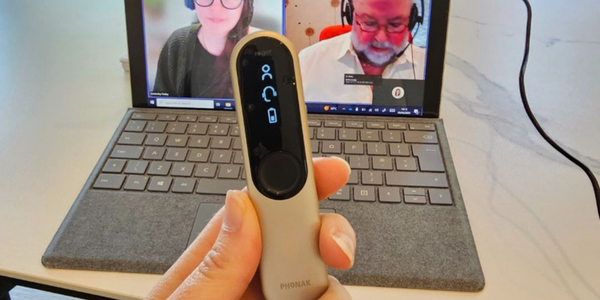
One of the most effective tools for hearing inclusion is the Phonak Roger On microphone. It transmits speech directly to compatible hearing aids, helping employees hear every word clearly, whether someone is in the room or calling in remotely.
Benefits of the Phonak Roger On for Hybrid Work
- Portable & versatile - can be used in a variety of environments: from small team huddles to on-the-go conversations, making it ideal for dynamic workplaces.
- Hybrid-ready - integrates seamlessly with laptops, conference calls, and standard meeting setups, ensuring that employees using hearing aids can fully participate, regardless of how their colleagues join the meeting.
- Multiple listening modes - adapts to different situations, like when you have a single speaker, a small group around a table, or hybrid meetings, automatically optimising audio to deliver improved clarity.
- Advanced noise management - with tech that homes in on the main speaker, the Roger On reduces background noise, helping employees focus on the most important speech and improving understanding in noisy environments.
- Boosts participation & confidence - by making conversations clearer and easier to follow, employees feel more confident contributing ideas, asking questions, and engaging in collaborative discussions.
The combination of all these features makes the Phonak Roger On a standout solution for workplaces looking to support hearing inclusion in every kind of meeting scenario.
Learn more about the Roger On Microphone >

Assistive Tech Isn't the Whole Solution
While devices like the Roger On are excellent, employers should remember that assistive technology is only one part of the bigger picture. Other strategies to support hearing inclusion include:
- Reviewing meeting culture to include things like agendas and summary sharing ahead of time so employees know what to expect
- Using live transcription or captions for remote calls as standard
- Inform teams of clear communication practices - speak clearly, face the microphone/screen, avoid talking over one another
By combining tech solutions with these inclusive meeting practices, organisations can create hybrid environments where all employees thrive.
Top FAQs About Hearing Inclusion for Hybrid Working
Q: What is the best microphone for hybrid meetings for hearing aid users?
A: The Phonak Roger On is a versatile, portable microphone that works with compatible hearing aids to improve speech clarity in meetings.
Q: Can technology alone make meetings accessible for deaf and hard of hearing people?
A: Technology helps, but inclusive practices like clear agendas, captions, and meeting summaries are equally important. One of the most important things a business can do is teach awareness and understanding to the entire workforce.
Q: How can I make my hybrid workplace more hearing friendly?
A: Combine assistive tech like the Roger On with good communication habits: face the person speaking, reduce background noise, and provide written meeting summaries. It's also really important to ensure all staff are deaf-aware and know how to be supportive, patient, and inclusive colleagues.
Level the Playing Field
Hybrid work doesn't have to disadvantage employees with hearing loss. Investing in the right assistive technology (like the Roger On!), alongside thoughtful communication practices can bridge gaps, improve engagement, and show genuine inclusion.
Your next step:
👉 Learn more about hearing inclusion in the workplace, and download our free guide here!
Need friendly, expert advice? Give us a call! We’re always happy to help.
📧 Email us at info@connevans.com
📞 Call the team 01737 247571