
What Are Group Listening Systems? A Complete Guide to Better Hearing for Tours, Museums, Meetings and More


Whether you're leading a museum tour or welcoming visitors to a heritage site, when you're hosting a large group or supporting customers with hearing loss, it's essential to ensure that everyone can participate.
Hearing clearly can become much more challenging in crowded or busy environments. Background noise, distance from the speaker and poor room acoustics can all make it difficult to follow what's being said - even when some listeners might be wearing hearing aids.
This is where group listening systems can really make all the difference.
Designed to deliver clear speech directly to every listener, group listening systems improve speech clarity, reduce listening effort and create a more inclusive experience for everyone.
What is a group listening system?
A group listening system is an assistive listening system that allows a speaker, presenter or tour guide to transmit their voice wirelessly to one or more listeners.
Rather than relying on the listener hearing the person speaking from across a room or through background noise, the speaker's voice is captured by a microphone and transmitted directly to a receiver - such as headphones or their hearing aids.
By improving the signal-to-noise ratio, group listening systems make speech significantly clearer while reducing the impact of competing background noise, reverberation and distance. This allows listeners to focus on the conversation instead of struggling to hear every word.

Why are group listening systems needed?
Even the latest hearing aids and cochlear implants have their limitations.
Many people find that hearing is particularly difficult when:
- Multiple people are speaking
- There is background chatter or competing noise
- The speaker is several metres away
- Rooms have echo or poor acoustics (like in a church or cathedral)
- They are moving around on a guided tour
- The speaker isn't always able to face the person listening
These challenges don't only occur for people with hearing loss. Those with typically good hearing can also miss important information when a speaker is competing with background noise, is too far away or is talking while the group is moving around.
These situations require much greater listening effort and can quickly become tiring, you might even notice visitors start to lose interest or drop off the tour all together.
A group listening system overcomes these challenges by transmitting speech directly to each listener, rather than relying on the sound travelling across the room.

Key benefits of group listening systems
Improved speech clarity
The biggest benefit is clearer speech. Instead of competing with background noise, the speaker's voice is delivered directly to each listener, making conversations much easier to understand.
Reduced background noise
Busy environments often contain:
- Traffic
- Air conditioning
- Echo / poor acoustics
- Background chatter and conversations
- Machinery
- Crowds
Remote microphone technology used in group listening systems can significantly reduce the impact of these competing sounds, allowing the listener to focus on the speaker's voice.
Hear over greater distances
As the distance between speaker and listener increases, speech naturally becomes quieter and more difficult to understand.
Group listening systems remove this problem by transmitting the speaker's voice directly to the listener via their hearing device or headphones, whether they're standing a few metres away or even facing away completely.
Less listening fatigue
Concentrating on hearing all day can be exhausting, but by making speech easier to understand, group listening systems reduce listening effort and help users stay engaged for longer.
Inclusive for a wide range of users
Many systems can be used by:
- Hearing aid users
- Cochlear implant users
- BAHA (Bone Anchored Hearing Aid) users
- People without hearing aids using dedicated receivers like headphones
This flexibility means a system can support a group of people with different hearing needs, as well as those who simply find listening difficult in particular environments. Not everyone using a receiver will have hearing loss - some may just want to follow a guide without being distracted by surrounding noise.
Typical use cases - who are they for?
Guided tours
Tour guides can speak naturally and at a comfortable volume level while visitors hear every word through their personal receiver. Perfect for places like museums, heritage sites, city walking tours and National Trust properties.
Conferences and presentations
People sitting in the audience can receive clear speech without being affected by room acoustics, background noise or distance from the speaker.
Visitor attractions
Whether explaining an exhibit or leading an experience behind the scenes, guides can communicate clearly with larger groups without straining their voice or worrying about the whole group being able to hear.
Corporate visits
Factories, warehouses and businesses offering site tours can provide an accessible experience for every visitor.
Educational visits
Schools, colleges and universities can support students who are deaf or hard of hearing during lectures, tours and group activities.

Why choose the Phonak Roger Group Listening System?
The Phonak Roger Group Listening System is designed specifically for guided tours and group communication - these systems are ideal for pretty much any situation where somebody is addressing a group of people.
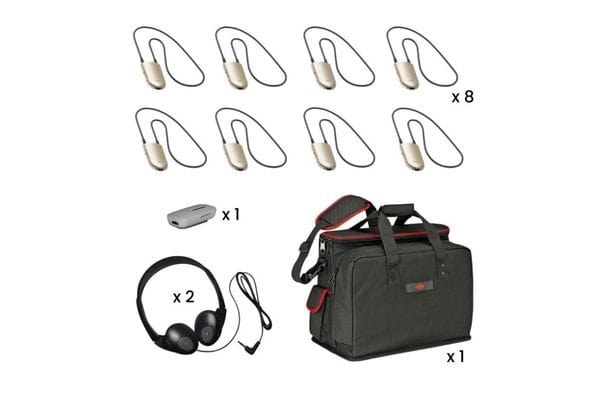
The system combines Roger wireless microphone technology with multiple receivers, allowing several listeners to hear the guide clearly at the same time.
Key features of the kit include:
- Excellent speech clarity in noisy environments
- Improved signal-to-noise ratio
- Wireless transmission over distance (up to 20m, depending on the system chosen)
- Supports multiple listeners, with flexibility to choose larger or smaller systems depending on group sizes
- Portable and easy to set up
- Suitable for indoor and outdoor use
- Compatible with hearing aids, cochlear implants and dedicated receivers (such as headphones)
Roger technology constantly adapts to changing noise levels, helping keep speech clear even in the busiest listening environments. It also supports multiple microphones working together for situations with several speakers or guides.
Creating more accessible experiences for visitors
Providing clear communication is an essential part of accessibility. For many deaf and hard of hearing people, being able to catch every word can mean the difference between fully enjoying a guided experience and struggling to keep up, experiencing listening fatigue and ultimately losing interest.
Making listening easier can benefit everyone, not just those with hearing loss. There are many factors that can create extra barriers leaving visitors struggling to follow along, regardless of their hearing level.
Whether you're running a museum, organising tours, delivering training or welcoming visitors to your business, a group listening system helps ensure everyone can participate comfortably and with confidence.
Explore our range of group listening systems
At Connevans, we supply a range of Phonak Roger Group Listening Systems designed for visitor attractions, guided tours and organisations looking to improve accessibility.
Whether you're supporting small groups or larger guided experiences, our team are happy to help you choose the right solution for your venue and visitors.
📧 Email us: info@connevans.com
📞 Call us: 01737 247571
🔗 Shop online: www.connevans.co.uk